
With human’s life flooded with wireless devices, all sorts of technology, especially Wi-Fi, are now evolving in the rapidest pace of all time. The iteration of Wi-Fi technology has now come to the generation of Wi-Fi 6e. In fact, the “e” stands for “Extended”, it is also known as 802.11ax. While the preceding Wi-Fi 6 has already implemented some state-of-the-art features, Wi-Fi 6e has released the full potential with an extended 6 GHz spectrum which has an additional bandwidth of 1200 MHz.
With human’s life flooded with wireless devices, all sorts of technology, especially Wi-Fi, are now evolving in the rapidest pace of all time. The iteration of Wi-Fi technology has now come to the generation of Wi-Fi 6e. In fact, the “e” stands for “Extended”, it is also known as 802.11ax. While the preceding Wi-Fi 6 has already implemented some state-of-the-art features, Wi-Fi 6e has released the full potential with an extended 6 GHz spectrum which has an additional bandwidth of 1200 MHz.
Wi-Fi 6 vs Wi-Fi 6e: What is the difference?
Wi-Fi 6e has inherited all the new features that was introduced by Wi-Fi 6 and to avoid competing for bandwidth resource in a cleaner spectrum of 6 GHz band to achieve a much lesser network congestion.
| WI-FI 5 | WI-FI 6 | WI-FI 6e | |
|---|---|---|---|
| Spectrum | 2.4 GHz, 5 GHz | 2.4 GHz, 5 GHz | 6GHz |
| Bandwidth | 20, 40, 80, 80+80, 160 | 20, 40, 80, 80+80, 160 | 20, 40, 80, 80+80, 160 |
| MU-MIMO | 4 x 4 for DL, 1 x 1 for UL | 8 x 8 (for both UL and DL) | 8 x 8 (for both UL and DL) |
| Modulation | 16/64/256QAM | 16/64/256/1024QAM | 16/64/256/1024QAM |
| Capacity | 1 Client per channel | 74 Clients per channel (160MHz) | 74 Clients per channel (160MHz) |
| Data Rate | 3.5Gbps | 9.6Gbps | 9.6Gbps9.6Gbps |
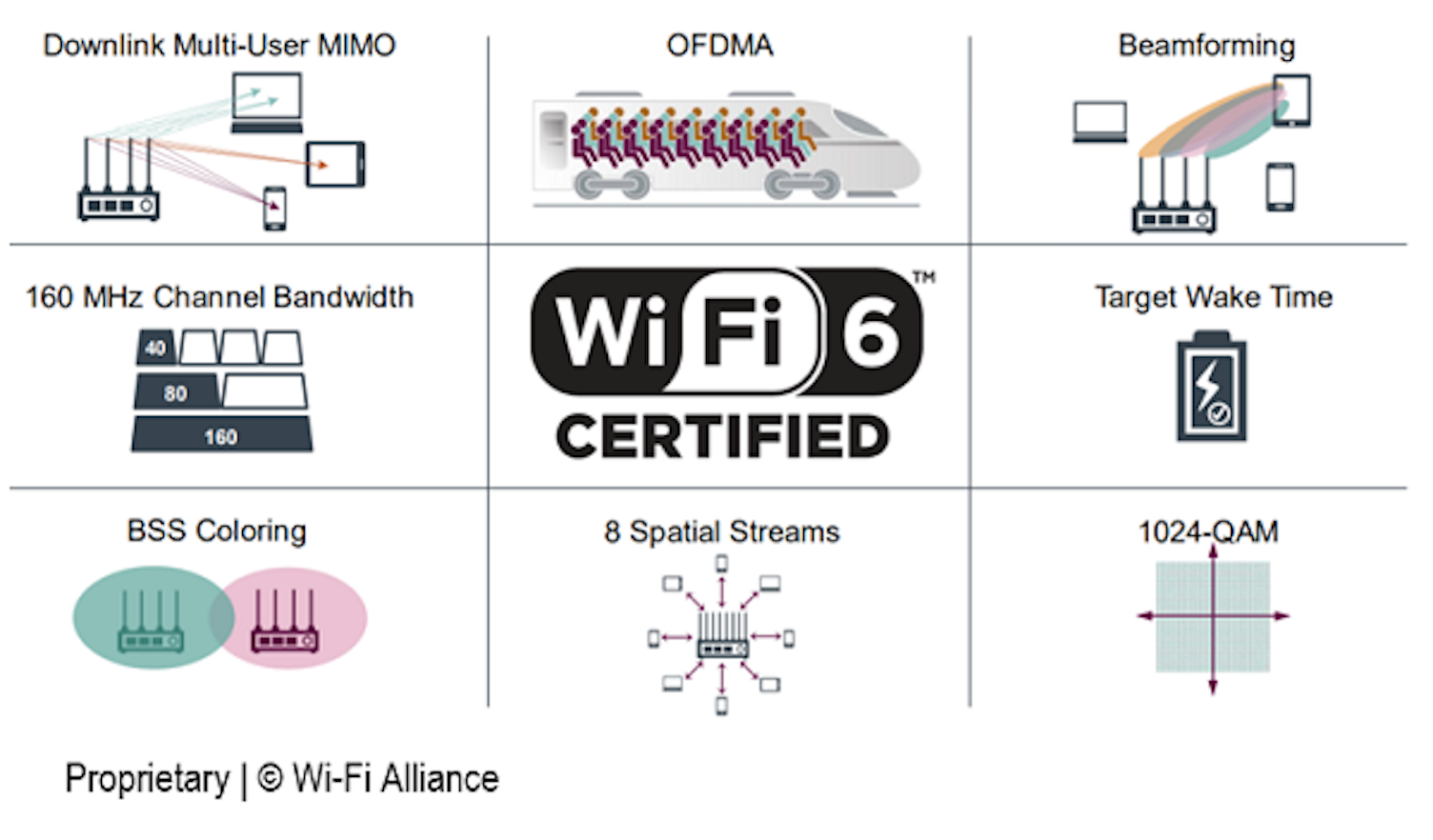
List of new features supported by Wi-Fi 6 and 6e:
- Orthogonal Frequency Division Multiple Access (OFDMA): With the use of narrower subcarrier and different resource unit configuration, user is now able to have a more efficient spectrum sharing mechanism, which also has lower latency for both uplink and downlink communication
- DL/UL MU-MIMO: Both uplink and downlink communication now support up to 8x8 MIMO for multiple users, which significantly increase the throughput of the network
- 1024QAM: A higher data rate is achieved by supporting the 1024QAM modulation scheme
- Spatial Reuse (SR) & BSS (Basic Service set) Coloring: BSS coloring enable better spatial reuse through its understanding of the spatial relationships. In other words, this technology gives Wi-Fi 6 the ability to discover spatial reuse opportunities and enable more parallel conversation within the same physical space
- Extended Range (ER): AP of Wi-Fi 6 can advertise ER BSS with a special ER beacon that uses a 242-tone RU transmitted in the primary 20 MHz channel to improve the coverage
- Target Wake Time (TWT): This new feature allows for a longer and more flexible node period as well as sleep scheduling for multiple STAs, which greatly improves the battery life of IoT sensors and other devices
Regulatory requirement:
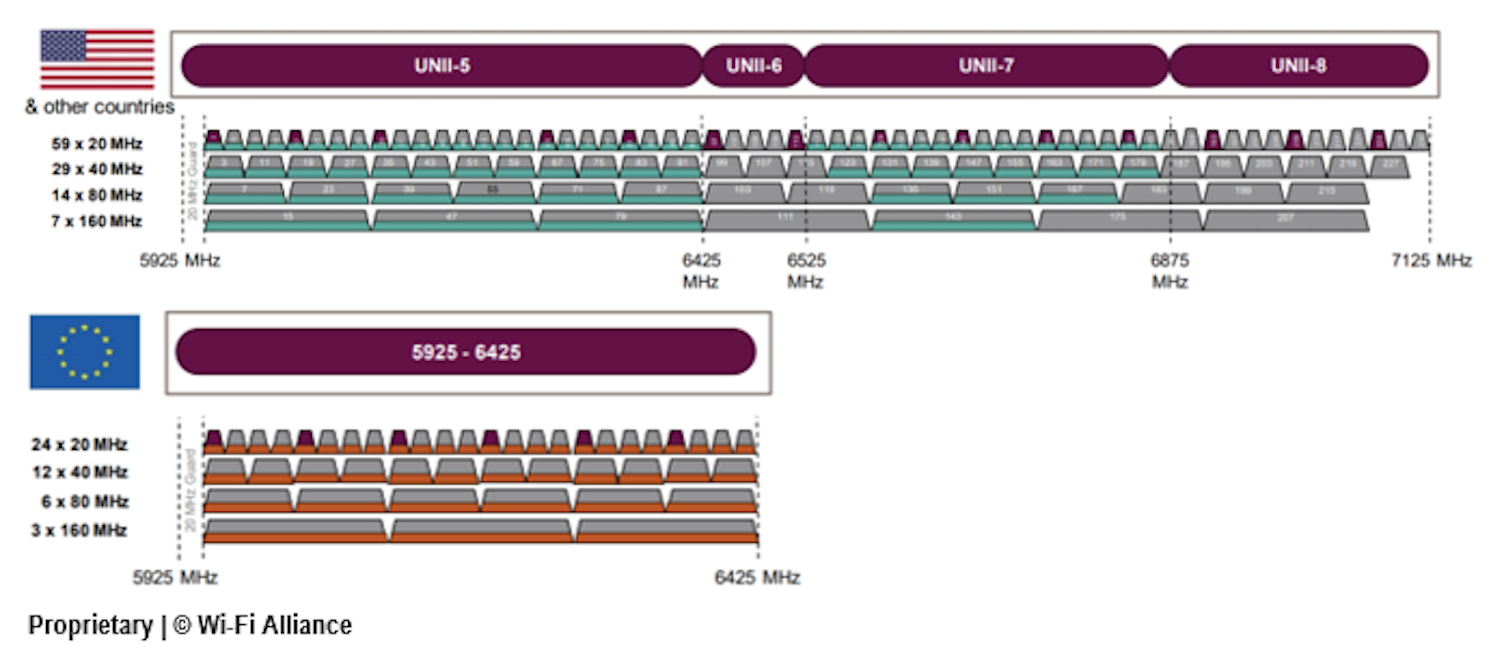
Although 6 GHz band is a cleaner spectrum but not vacant. Some terrestrial microwave and satellite applications are also an incumbent user of this band. Thus, regulatory bodies such as FCC and ETSI announced some new requirements regarding the new application in this band. So far, FCC has defined several device categories for outdoor and indoor installation. And the requirements are set forth in CFR 47 Part 15.407 with applicable KDB 987594. And a draft version of EU standard ETSI EN 303 687 is also under preparation for official publication in 2022 according to current schedule.
Spectrum allocation:
SGS Services for Wi-Fi 6e:
To address the growing demand for Wi-Fi 6e, we can provide our clients with the most up to date one-stop solution including both testing and certification services. Although regulatory compliance bodies have introduced new requirements including complex and time-consuming test procedures to ensure every device operating in the 6 GHz will not cause any harmful and unwanted interference, SGS experts are capable to significantly reduce the turnaround time by taking advantage of our state-of-the-art system and highly automated testing software. |  |
SGS offer the broadest range of wireless communications testing and compliance services from a global network of laboratories to give you the edge in a competitive marketplace.
Please contact our Customer Service Team for more information!
To obtain a copy in PDF, please click here.



Units 303 & 305, 3/F, Building 22E,
Phase 3, Hong Kong Science Park,
Pak Shek Kok, New Territories, Hong Kong, China